How to Clear a Check Engine Light With an OBD2 Scanner (and When Not To)
Published October 30, 2026
Quick answer
Yes, an OBD2 scanner can clear the check engine light: the clear command erases stored and pending engine codes, switches off the malfunction indicator lamp and resets the I/M readiness monitors. It does not repair anything, so if the fault is still live the light returns within a drive cycle or two. The useful skill in How to Clear Check Engine Light with OBD2 Scanner is reading and recording the codes and freeze frame first, then deciding whether erasing is honest or just hides a problem.
Table of contents13 sections · tap to expand
Key takeaways
- The clear command wipes stored and pending codes, turns off the light and resets readiness monitors; it never fixes the underlying fault.
- Record stored codes, pending codes, freeze frame and live data before erasing, because that evidence is what a shop needs if the light returns.
- Clearing codes sets emissions monitors to not ready, so a smog test right afterward can fail even on a healthy car.
- A flashing check engine light means stop driving and diagnose, not clear.
- ABS, airbag, brake, steering and oil-pressure warnings are not check engine codes and should go to a mechanic.
Our pick for this
Autel AL319 Code Reader
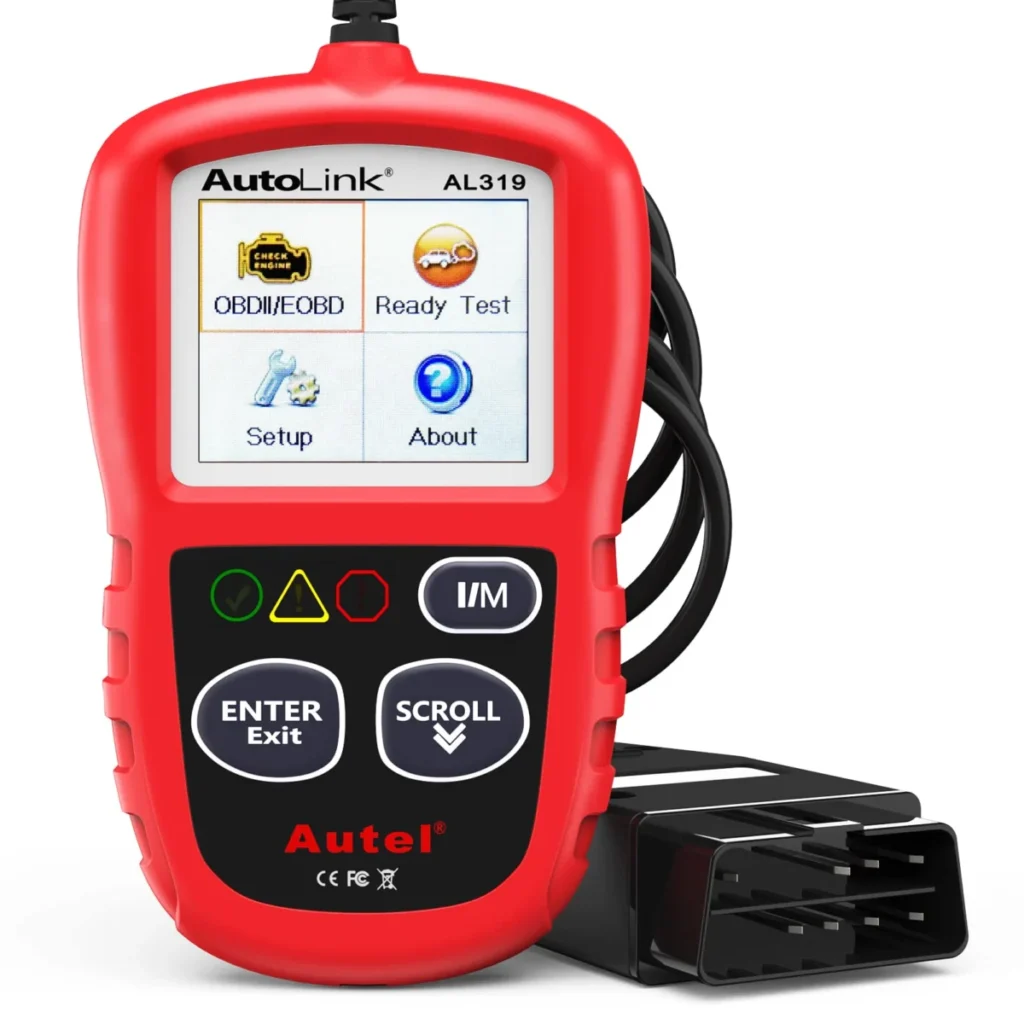
- Why we pick it: Wired code reader with read and clear, freeze frame, live data, I/M readiness and VIN, CAN support, seven languages and free lifetime updates, so the basic clear procedure is covered without extra complexity
- Best for: Reading, recording and clearing engine codes on a post-1996 OBD-II car
- Keep in mind: Engine codes only; it cannot see ABS, airbag or transmission modules
As an Amazon Associate we earn from qualifying purchases. This never changes which products we recommend.
Recommended products
Products that fit this
| Product | Best for | Where to buy |
|---|---|---|
| Autel AL319 Code Reader | Reading, recording and clearing engine codes on a post-1996 OBD-II car | Check price on Amazon |
| KONNWEI KW850 Code Reader | Diagnosing emissions-related faults before clearing, such as EVAP or O2 sensor codes | Check price on Amazon |
| ANCEL AD310 Scan Tool | Clearing engine codes when ABS, airbag or transmission warnings are also present | Check price on Amazon |
Can an OBD2 scanner clear the check engine light?
An OBD2 scanner can clear the check engine light because the clear command is a standard OBD-II function: the tool sends a request to the engine control module (PCM) to erase diagnostic trouble codes and switch off the malfunction indicator lamp. On most tools this is a single menu item labeled Clear Codes, Erase or Reset.
What the command erases is specific. It removes stored codes (faults the PCM confirmed), pending codes (faults seen once but not yet confirmed), freeze frame data captured at the moment of the fault, and it resets the I/M readiness monitors to not ready. Permanent codes are different: they are stored by the PCM itself and generally clear only after the module confirms the repair across several drive cycles, so a scanner erase may not remove them.
What the command does not do is fix the car. A trouble code points to a circuit or system, not always to a failed part, and a P0420 catalyst efficiency code or a P0455 EVAP leak code can have several causes. Clearing the light on a live fault buys time until the PCM re-runs its tests and sets the code again.
One more limit matters for buying decisions: a basic code reader only reaches engine and emissions data. ABS, airbag, transmission and body faults live in other modules and need enhanced or manufacturer-specific support, so a tool that clears a check engine light may not even see an ABS warning.
Before you erase anything: read and record the codes
Read every code and save the freeze frame before clearing, because the erase destroys the evidence a mechanic would use to confirm the diagnosis. The freeze frame records the engine conditions (rpm, load, coolant temperature, speed) at the moment the fault set, which often narrows the cause faster than the code itself.
Connect the scanner to the 16-pin diagnostic link connector, usually under the dash on the driver's side within reach of the steering wheel. Turn the ignition to the on position without starting the engine (key-on, engine-off) unless the tool's instructions say otherwise, then let the scanner identify the protocol: CAN and ISO 15765 on most 2008-and-newer cars, and older J1850 PWM, J1850 VPW, ISO 9141-2 or KWP2000 on earlier OBD-II vehicles.
Read in this order: stored codes, then pending codes, then permanent codes if the tool lists them. Write down each code and its description, note whether it is generic (P0xxx) or manufacturer-specific (P1xxx), and photograph the freeze frame screen. If the tool shows live data, note the readings for the sensors the code implicates, such as upstream and downstream O2 sensor voltages for a catalyst code.
This record is also your repair log. If you replaced a gas cap, ignition coil or O2 sensor and the same code returns, the saved freeze frame tells you whether the fault is identical or a new one.
Want to skip the research? The Autel AL319 Code Reader is the model we would start with.
Step-by-step: how to clear the check engine light with an OBD2 scanner
The procedure below is the order to follow on any OBD-II car, and each step names the result to expect. Do the reading steps first even if you only want the light off, because the clear command is irreversible for that fault record.
- Locate the OBD-II port: a 16-pin trapezoid connector under the driver's side dash, sometimes behind a small cover or near the center console. Result: you have a clear socket to plug into.
- Plug in the scanner with the ignition off, then turn the ignition to on without cranking the engine. Result: the tool powers up from the port and asks for the vehicle or auto-detects the protocol.
- Select the read function and let the scanner pull stored, pending and permanent codes. Result: a code list, or a no codes found message if the light was cleared elsewhere.
- Record the codes, freeze frame and any live data you need, as described above. Result: you have a written or photographed record before anything is erased.
- Start the engine if the tool's instructions call for it, and confirm the check engine light is actually on. Result: you know the lamp state the PCM is reporting.
- Choose Clear Codes or Erase and confirm the prompt. Result: the scanner reports codes cleared and the check engine light goes out, usually within a few seconds.
- Turn the ignition off, wait about ten seconds, then restart and re-read codes. Result: no stored codes if the fault is repaired; the same code or a pending version if it is still live.
- Check I/M readiness in the scanner menu. Result: most or all monitors read not ready, which is expected after an erase and tells you a drive cycle is needed before a smog check.
What clearing codes does to readiness monitors and a smog check
Clearing codes resets the I/M readiness monitors, and an emissions test can fail on readiness alone even when the car has no faults. Readiness monitors are the PCM's self-tests of systems such as the catalyst, oxygen sensor, EVAP system and misfire detection; an erase marks them not ready until the car completes the drive cycles that let each test run.
Most states allow one or two monitors to remain not ready, and many will not test a car with too many incomplete, so clearing a light the day before a smog check is a poor strategy. The car needs a proper drive cycle, typically a mix of cold start, steady highway speed and idle periods defined by the manufacturer, before the monitors set again.
The practical sequence is diagnose, repair, clear once, then drive normally for several days and recheck readiness before the test. If a monitor refuses to set, that itself is a clue: an EVAP monitor that never completes can point to a small leak or a sensor the PCM cannot validate.
When the light comes back, stays on, or flashes
A light that returns immediately after clearing means the fault is live and the PCM has re-confirmed it, so the next move is diagnosis, not another erase. Re-read the codes and compare them with your saved record: the same code points back to the same circuit, while a new code may be a consequence of the first.
A flashing check engine light is a different category and means stop driving. Flashing signals a misfire severe enough to damage the catalytic converter, so clearing it and continuing can turn a repair into a much larger one. Pull over safely and arrange diagnosis.
Freeze frame and live data are how you decide between a DIY fix and a shop. If the freeze frame shows a lean condition at idle with a P0171 and live data shows the fuel trims climbing, the cause is likely a vacuum leak or a dirty mass airflow sensor; if a P0300 misfire follows one cylinder, swap the coil and see whether the misfire moves. A scanner reads the data, but the interpretation and the repair are yours or your mechanic's.
When you should not clear the code
Do not clear a warning for ABS, airbag (SRS), electronic parking brake, steering or oil pressure as if it were a check engine light. Those warnings involve safety systems, and a scanner that only reads engine codes will not even see them; a tool with enhanced coverage may read them, but the right response is diagnosis by a qualified mechanic, not an erase.
Never keep driving with a brake, airbag, steering or oil-pressure warning on the assumption that clearing the light made it safe. A scanner reads and clears data; it does not repair a hydraulic, restraint or steering fault, and it cannot tell you the system is sound.
Clearing codes to sell a car, or to get through an emissions test without repairing the fault, is emissions tampering in spirit and usually fails anyway once the monitors reset and the fault returns. The honest path is repair, then clear, then let the monitors set.
When in doubt, consult the service manual for the specific code and system, and hand the saved codes and freeze frame to a mechanic. That record shortens diagnosis and often reduces the bill.
Which tool to use for the job
Any OBD2 code reader can clear engine codes, so the choice comes down to how much you want to see before and after the erase. A basic code reader reads and clears engine codes, shows freeze frame and I/M readiness, and is enough for a DIYer who fixes a known fault and wants to confirm it. A scan tool with live data and graphing helps when you are diagnosing rather than just clearing.
A bidirectional scan tool can also run active tests and service resets, which matters for brakes, ABS bleeds and oil or battery resets. A Bluetooth or Wi-Fi OBD2 adapter with a phone app moves the display to your phone but depends on the app for what it can do.
The Autel AL319 is a wired code reader for engine codes only, with read and clear, freeze frame, live data, I/M readiness and VIN, seven languages, CAN support and free lifetime updates. It suits the owner who wants a simple, screen-based tool to read the code, record it and clear the light after a repair, and it is the least complicated starting point for a first scanner.
It cannot see ABS, airbag or transmission modules, so it is the wrong tool for a chassis warning light.
The KONNWEI KW850 is also a wired engine-only code reader, but it adds O2 sensor and EVAP test functions, a battery test and a built-in library of more than 8,000 generic code definitions, with updates included and a 2.8-inch color screen. Choose it if you want more diagnostic depth on emissions-related faults, such as an EVAP leak you are trying to trace, and accept that it still reads engine data only.
The ANCEL AD310 is listed as an enhanced scan tool covering engine, ABS, SRS airbag and transmission systems, with read and clear, freeze frame, live data and I/M readiness across CAN, J1850, ISO 9141 and KWP2000. For a reader who also faces an ABS or airbag light, that broader module coverage is the reason to pick it over an engine-only reader; confirm compatibility with your specific vehicle before buying, because enhanced coverage varies by make and model.
Helpful tool
ANCEL AD310 Scan Tool

- Helps with: Clearing engine codes when ABS, airbag or transmission warnings are also present
- Keep in mind: Enhanced module coverage varies by vehicle, so compatibility with your specific car should be confirmed before purchase
Clearing the light without a scanner
Disconnecting the battery negative cable for a few minutes will usually extinguish the check engine light, because the PCM loses its keep-alive memory and the stored codes with it. It is a blunt version of the clear command with the same core problem: it erases the evidence and resets readiness monitors without fixing anything.
The side effects are worse than a scanner erase. Many cars lose radio presets and clock settings, some need idle relearn or window and steering-angle calibration afterward, and modern vehicles may store a low-voltage or communication code of their own. You also learn nothing about why the light came on.
A cheap code reader costs less than the diagnostic time it saves and gives you the code, the freeze frame and a clean clear command. If you only need to read and erase engine codes, an entry-level wired reader is the sensible purchase; if you also see ABS or airbag warnings, buy a tool with enhanced module coverage instead of erasing blind.
Avoid these
Common mistakes to avoid
- Clearing the codes before writing them down. Read stored, pending and permanent codes and photograph the freeze frame first; the erase destroys the record a mechanic needs.
- Clearing the light right before an emissions test. Repair the fault, clear once, then complete a drive cycle and confirm the I/M readiness monitors are ready before testing.
- Treating a flashing check engine light as something to erase. A flashing light signals a misfire that can damage the catalytic converter; stop driving and diagnose it.
- Using an engine code reader on an ABS, airbag or brake warning. Those systems need enhanced module coverage and proper diagnosis; an engine-only reader cannot see them.
- Assuming a cleared light means a fixed car. If the fault is live, the PCM re-confirms it and the light returns; use the saved codes and live data to find the cause.
Useful tools
Tools that help
As an Amazon Associate we earn from qualifying purchases. This never changes which products we recommend.
Helpful tool
KONNWEI KW850 Code Reader

- Helps with: Diagnosing emissions-related faults before clearing, such as EVAP or O2 sensor codes
- Why it fits: Adds O2 sensor and EVAP tests, a battery test and a library of more than 8,000 generic code definitions on a 2.8-inch color screen, with updates included
- Keep in mind: Still reads engine data only, and the manufacturer states it does not work on hybrid or electric cars
Common questions
Frequently asked questions
Will the check engine light turn off by itself if the problem is fixed?
Usually yes. Once the PCM completes the relevant self-tests and sees the fault is gone, it can extinguish the light on its own after a number of drive cycles, though the stored code may linger in history for a while. Clearing manually is faster but skips that confirmation.
Does disconnecting the battery clear the check engine light?
It often does, because the PCM loses stored codes when its memory loses power. The catch is that it also resets readiness monitors and can wipe radio and clock settings or trigger relearn procedures, and it tells you nothing about the fault.
Can I pass an emissions test right after clearing the codes?
Rarely. An erase sets the I/M readiness monitors to not ready, and most testing programs reject a car with too many incomplete monitors. Drive the car through a full drive cycle and confirm readiness before the test.
Why does my scanner say it cleared the code but the light is still on?
The fault is probably still active, so the PCM re-ran its test and set the code again within the same drive cycle. Some lamps also stay lit until the next key cycle, and permanent codes can survive an erase until the module confirms the repair.
Do I need a bidirectional scan tool just to clear a check engine light?
No. Any OBD2 code reader can clear engine codes. Bidirectional control matters for active tests, ABS bleeds, electronic parking brake retraction and service resets, which are separate jobs from turning off a check engine light.
Can a Bluetooth OBD2 adapter clear codes on an iPhone?
Many can, provided the adapter supports iOS (Wi-Fi or Bluetooth LE) and the app includes a clear function. The adapter only provides the connection; what it can read and erase depends on the app and on whether the car's modules are supported.
Next step
Read and record your codes and freeze frame first, then pick a tool that matches what you actually see: the Autel AL319 if you only need engine codes read and cleared, the KONNWEI KW850 if you want extra emissions tests and a code library, or the ANCEL AD310 if ABS, airbag or transmission warnings are also on your dash.
Keep reading
Free OBD2 Code Reading: What a Store Scan Shows and What It Hides
A free OBD2 code reading gives you engine codes and little else: no ABS, airbag or live data. See what a store…
How Much Does a Scan Tool Cost? Price Tiers by What They Can Read
A clear, practical answer to how much does a scan tool cost, with the steps, the common mistakes and what to do…
OBD1 vs OBD2 Scanner: Which One Your Car Needs and What to Buy
Pre-1996 cars need brand-specific OBD1 cables and code schemes; 1996-and-newer cars use one OBD2 port. Learn what each tool reads and which…